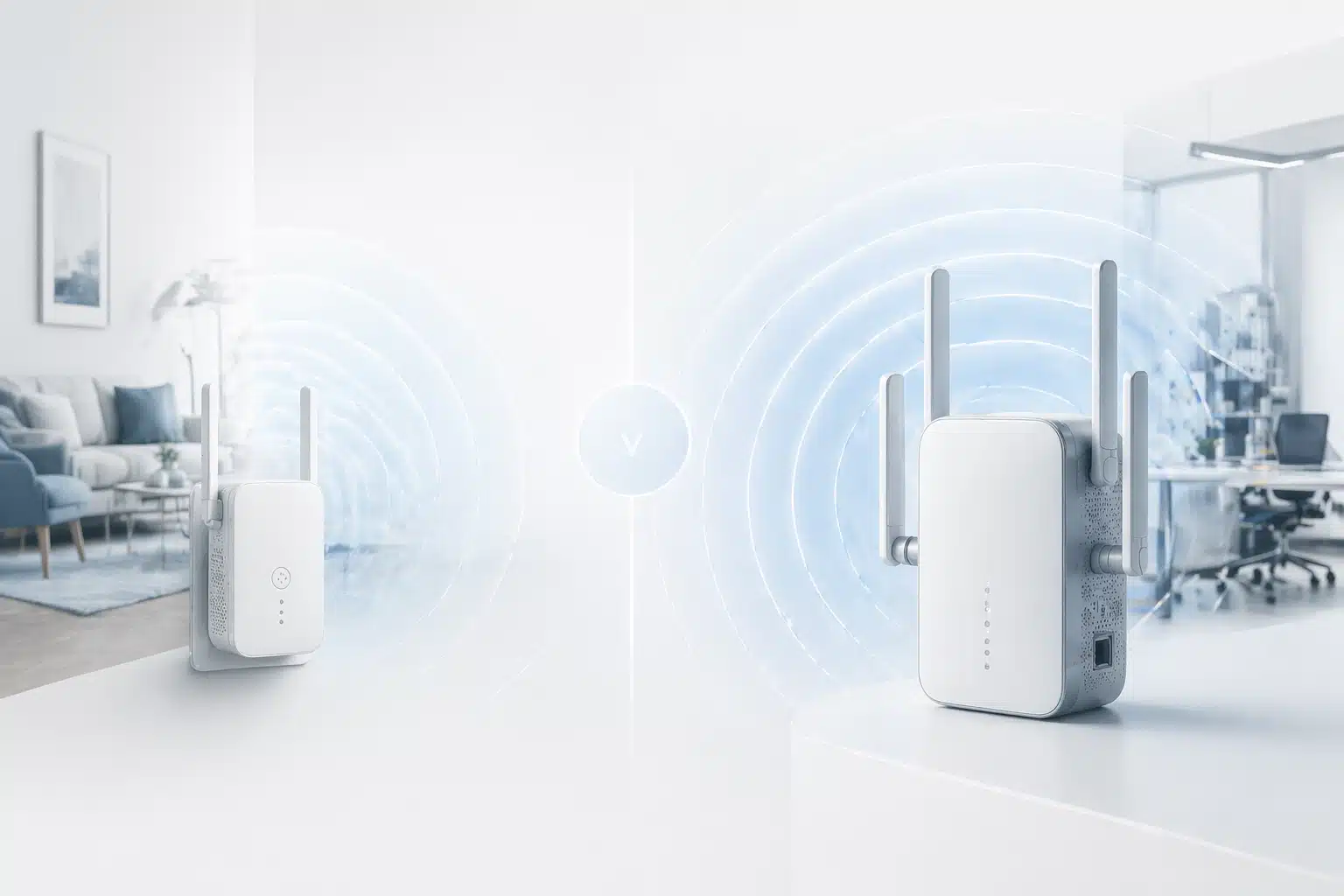
If you only need to extend WiFi into a low-demand room for light browsing, messaging, or smart home devices, a single band WiFi repeater may still be enough. If you expect smoother streaming, more stable video calls, better multi-device support, or stronger performance in a busier environment, a dual band repeater is usually the better choice.
Who single band fits best
Choose this direction when the real job is simple WiFi extension for older routers, lighter traffic, and low-demand rooms where cost and basic coverage matter more than higher throughput.
Who dual band fits best
Choose this direction when users expect better real-world usability for streaming, video calls, mixed-device traffic, and more current router environments.
Quick Navigation
Single Band vs Dual Band at a Glance
This comparison matters because buyers are usually not asking only whether a repeater can extend the signal. They are asking whether the repeated area will still feel usable once devices actually connect and traffic starts flowing. In many real deployments, that is where the difference becomes visible.
| Comparison Point | Single Band WiFi Repeater | Dual Band WiFi Repeater |
|---|---|---|
| Main band support | Usually 2.4 GHz only | 2.4 GHz + 5 GHz |
| Best for | Simple dead zones, light home use, older router setups | Streaming, video calls, mixed-device homes, office use |
| Coverage behavior | Often easier to justify where basic reach is the priority | Better flexibility across mixed traffic needs |
| Throughput expectation | More limited under heavier load | Usually better suited to real multi-device use |
| Router matching | Often acceptable for older or simpler router environments | Usually a better match for modern dual-band routers |
| Buyer profile | Budget-focused, basic coverage extension | Performance-focused, busier or more future-ready environments |
Quick selection rule
- Choose single band if the goal is simple, low-cost coverage extension for light usage.
- Choose dual band if the goal is better real-world usability for streaming, video calls, or multiple active devices.

What Single Band Means
A single band WiFi repeater operates on one wireless band only. In many entry-level repeater products, that usually means 2.4 GHz. That does not automatically make it a weak product. It usually means the repeater is designed for simpler, lower-demand usage.
That can still be a practical choice in small homes, apartments, hallway dead zones, kitchen corners, smart device zones, or older router environments. If the network is only expected to support everyday browsing, messaging, app control, or light streaming, a single band repeater may still solve the real problem at lower cost.
The limitation appears when one band is expected to do everything at once. Once the repeater must handle both the upstream link and downstream client traffic under heavier load, the performance ceiling becomes more noticeable. This is where many buyers realize that “signal extension” and “good user experience” are not always the same thing.
If your audience is working with older routers, lower budgets, or more legacy-oriented projects, this is also where it makes sense to continue into Wireless-N WiFi Repeaters.
What Dual Band Means
A dual band WiFi repeater supports both 2.4 GHz and 5 GHz operation. In buying terms, that gives the deployment more flexibility. Some devices benefit from longer reach, while others benefit more from higher speed and lower congestion. A dual band repeater is better positioned to support that mixed behavior.
This does not mean that every dual band repeater will automatically maintain full router performance. It also does not mean every customer needs one. What it means is that the repeater has more room to support real usage conditions in a more current network environment.
That matters more in homes and offices where users are not only checking messages. They are streaming video, joining meetings, uploading files, switching between multiple devices, and expecting the extended zone to remain usable. In those situations, a dual band repeater is usually the more practical product class.
For buyers who already know they need a more mainstream dual-band direction, this is a natural place to continue into WiFi 5 Repeaters or WiFi 6 Repeaters.
Coverage vs Throughput Trade-Offs
This is the most important part of the selection logic. A repeater may improve signal reach, but that does not guarantee the same usable throughput that users experience near the router. Coverage and throughput are related, but they are not the same thing. A room can show stronger signal bars and still feel slow if the repeated link is weak, overloaded, or badly positioned.
This is why the single band vs dual band decision matters. According to Intel’s explanation of 2.4 GHz and 5 GHz WiFi behavior, 2.4 GHz generally offers better range, while 5 GHz typically offers higher speed over shorter distance. That aligns closely with how buyers should think about basic reach versus usable performance.
It is also worth noting that CDW’s overview of network extenders points out that usable speed can be reduced when traffic is received and retransmitted over the repeated link. In practical terms, this is one reason why “stronger signal” does not automatically mean “better experience.”
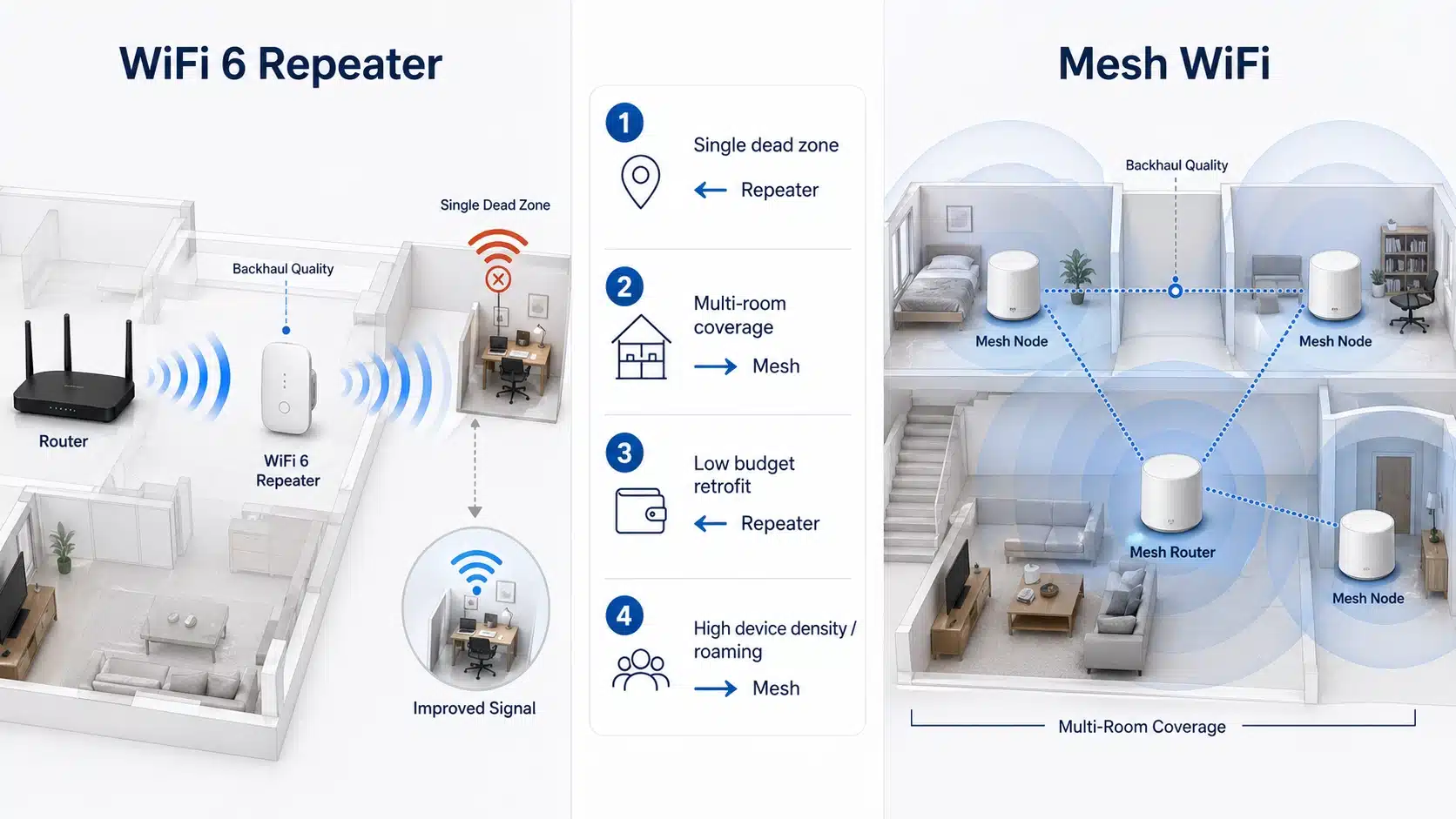
A repeater cannot create a better upstream link than the one it receives. In real deployment logic, one of the most common buyer mistakes is placing the repeater too far away from the router. If the repeater itself is already receiving a weak or unstable signal, the repeated connection will also be weak or unstable. A good repeater placed badly still performs badly.

Best for Basic Home Coverage
Single band repeaters make the most sense when the real problem is limited reach, not high traffic demand. Typical examples include a bedroom with weak WiFi, a hallway dead zone, a kitchen corner for smart appliances, or a smaller apartment using an older router.
In these cases, the buyer usually cares more about stable everyday coverage than maximum speed. If the devices are mainly phones, messaging apps, voice assistants, smart switches, cameras, or low-demand browsing devices, a single band repeater may still be the right fit.
This is also where more legacy-oriented product categories still matter. If the target market is working with older router ecosystems, simpler home layouts, or more budget-sensitive demand, a Wireless-N WiFi Repeater path is often more relevant than pushing every buyer toward a newer dual-band class.

Best for Office and Multi-Device Environments
Dual band repeaters are usually the better choice when the environment includes more users, more traffic, or more demanding device behavior. That includes home offices, meeting corners, front desk areas, serviced apartments, and shared multi-device households.
In these environments, users are not just checking messages. They are joining video calls, uploading and downloading files, switching between laptops and phones, streaming content, and expecting the extended WiFi area to remain stable while multiple devices are active.
Standard evolution also helps explain why this matters. In IEEE’s overview of WiFi evolution, WiFi 4, WiFi 5, and WiFi 6 reflect increasing expectations around throughput, efficiency, and denser wireless environments. That does not mean every dual band repeater is automatically a WiFi 6 product. It means newer deployment environments are increasingly shaped by device density and efficiency, not only raw signal reach.
For buyers comparing higher-spec deployment directions, this is where your WiFi 5 Repeaters and WiFi 6 Repeaters categories become especially relevant.

How to Match Repeater Band with Router Capability
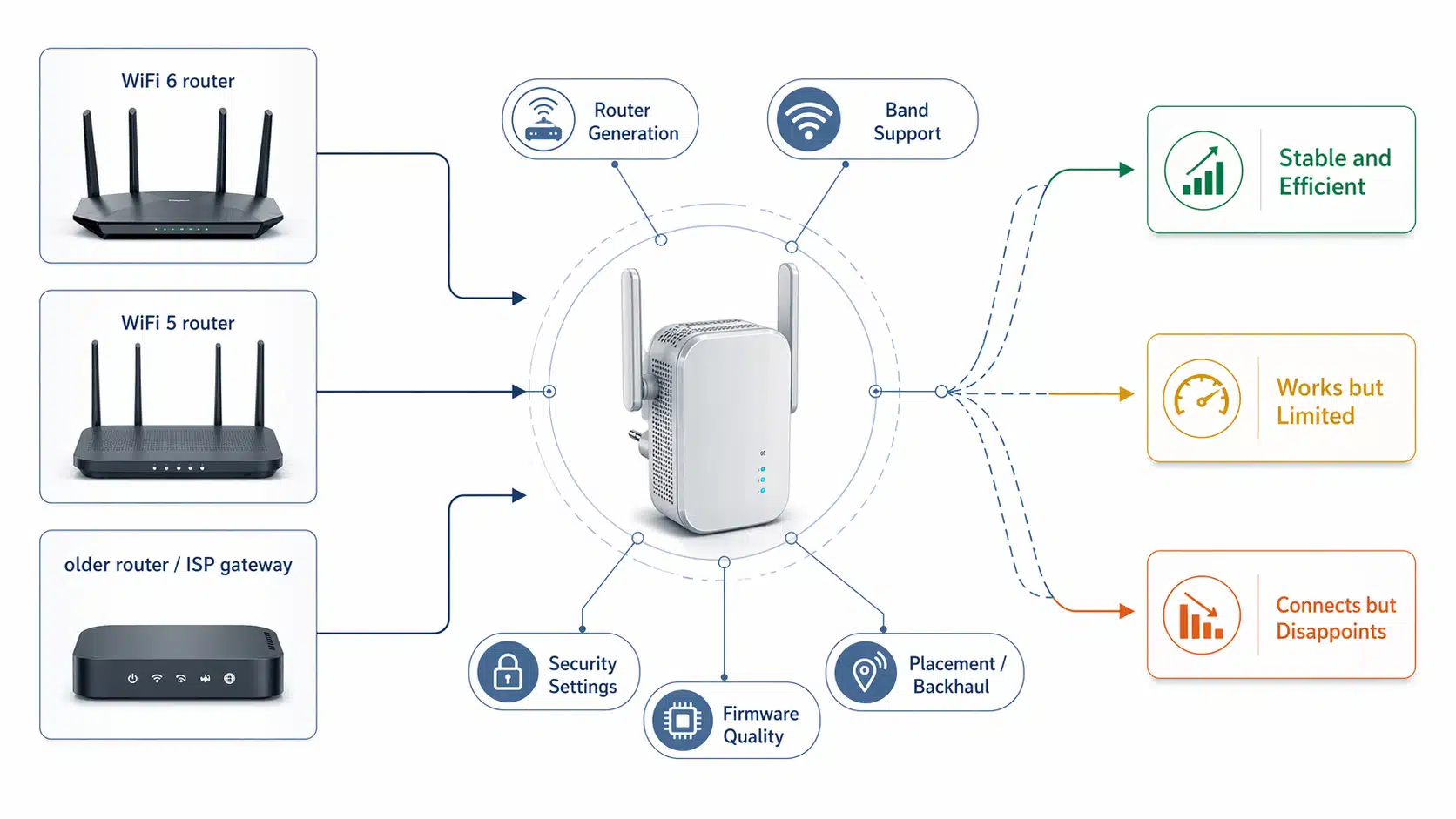
A repeater should always be selected with the router in mind. If the router is older, single band, and mainly operating in a low-demand environment, a single band repeater may still be enough. The repeater does not need to be more complex than the actual job requires.
If the router already supports dual band operation and users expect smoother streaming, more stable calls, or better multi-device behavior in the repeated area, a dual band repeater is usually the better match.
Practical matching rule
- Older router + light use + simple dead zone → single band may still be enough
- Dual-band router + mixed traffic + higher expectations → dual band usually makes more sense
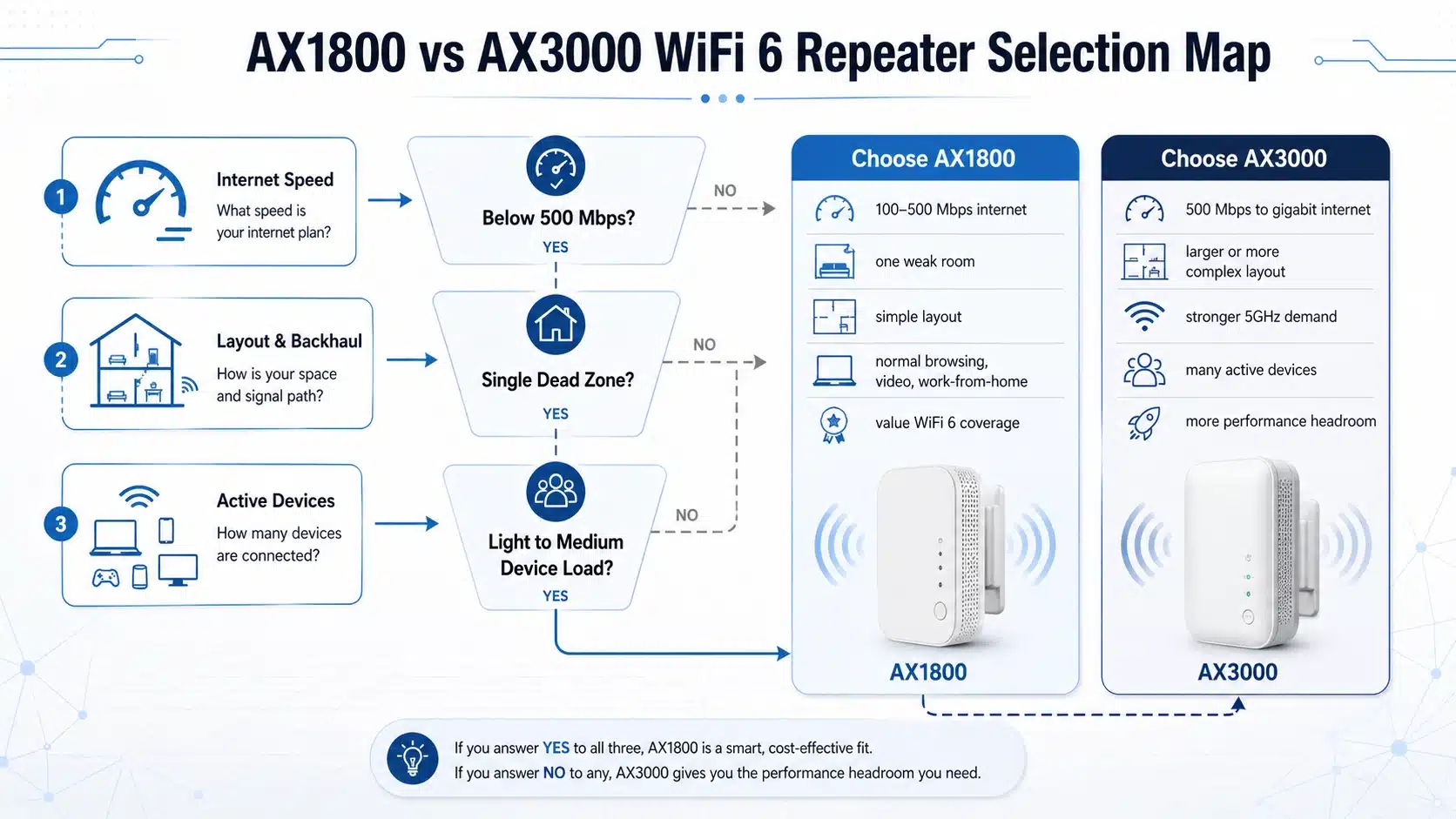
- Denser environment + newer client devices + stronger efficiency needs → evaluate WiFi 6 Repeaters
Common Mistakes Buyers Make
- Choosing by advertised speed alone. A larger speed number does not automatically mean better user experience. Placement, wall loss, interference, router quality, and repeated-link behavior all affect real performance.
- Confusing visible signal with usable WiFi. More signal bars do not always mean better throughput. A repeated connection can look stronger while still feeling limited in real use.
- Installing the repeater too far away. A repeater works best when it still receives a healthy upstream signal from the router. Placing it at the weakest edge of coverage usually creates disappointing results.
- Ignoring the router’s actual capability. Pairing a modern dual-band expectation with a very limited router often creates unrealistic performance expectations.
- Buying dual band when the usage is actually basic. Not every site needs a higher-cost solution. If the real job is simple low-demand extension, a single band repeater may still be the more sensible purchase.
- Buying single band for a busier mixed-device environment. The repeater may technically extend the signal, but the user experience often does not meet expectations once more devices are active.
Conclusion
If the goal is simple, low-cost WiFi extension in a light-use home environment, a single band WiFi repeater can still be the right product choice.
If the goal is better real-world performance in a busier environment with more devices, more streaming, more work traffic, or a more modern dual-band router, a dual band repeater is usually the better choice.
The most useful way to decide is not to ask which label sounds better. Ask what the site actually needs: basic coverage only, coverage plus usable throughput, older router compatibility, or more current multi-device support.
Wireless-N WiFi Repeaters
Best for older router ecosystems, simple extension needs, and more budget-sensitive projects.
WiFi 5 Repeaters
A practical dual-band direction for buyers who need higher throughput and more mainstream modern compatibility.
WiFi 6 Repeaters
Better aligned with denser environments, newer device expectations, and higher-efficiency deployment logic.