Long Range WiFi Repeaters
Best suited for warehouses, farms, campuses, parking areas, workshops, building-to-building links, and other hard-to-wire deployments.
-
Deployment: Outdoor / Semi-outdoor / Industrial
-
Coverage style: Omni / Directional
-
Link type: Repeater / AP / Bridge / CPE
-
Band: 2.4 GHz / 5 GHz / Dual-band
-
Use case: Yard / Farm / Warehouse / Building-to-building
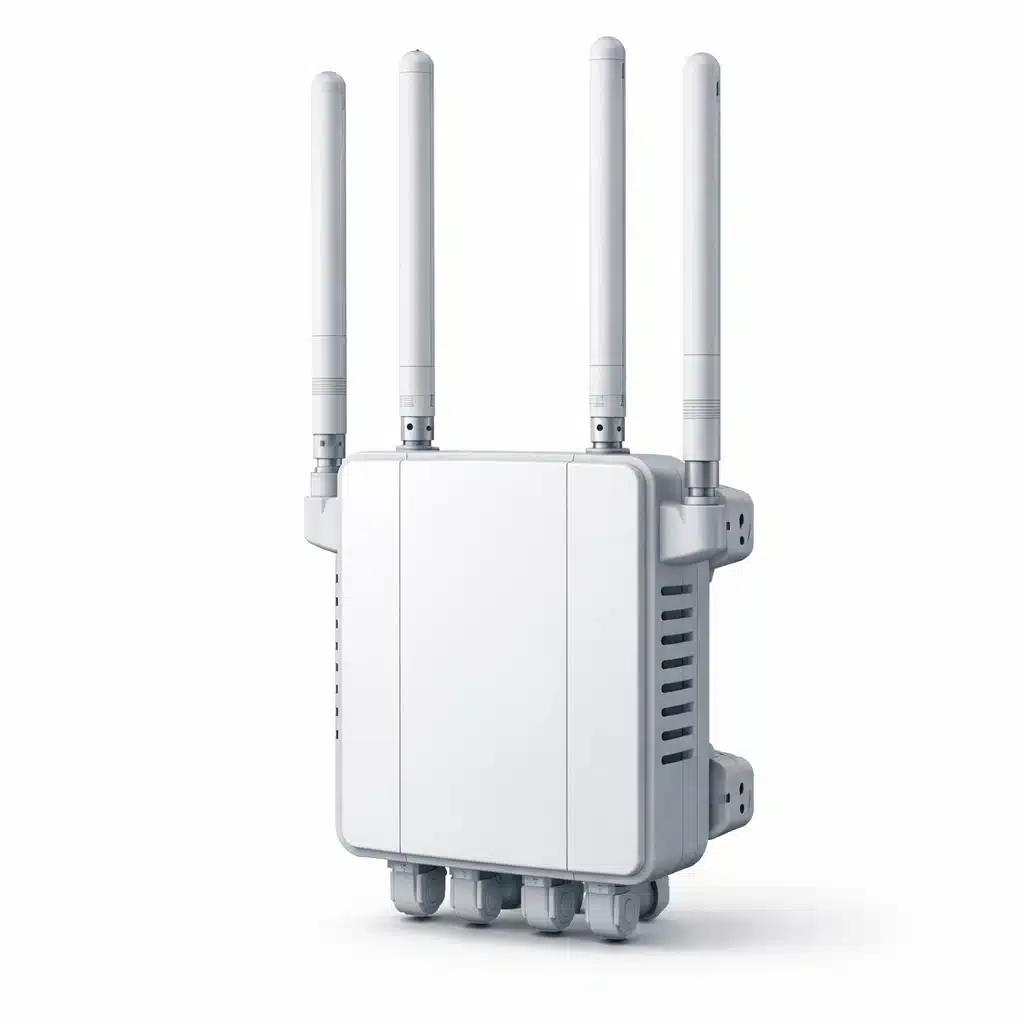
What “Long Range” Actually Means in WiFi Repeater Projects
Long range is not just about transmit power. In real deployments, distance depends on band selection, antenna design, mounting height, line of sight, interference level, and installation conditions.
Band selection changes the reach profile
2.4 GHz is usually chosen when coverage distance matters more than peak speed.
It generally provides better propagation over distance and through obstacles, while 5 GHz is often preferred when cleaner bandwidth and higher throughput are more important.
Antenna design often matters more than raw power claims
As distance increases, antenna type becomes one of the biggest factors in usable signal delivery.
Omni antennas spread signal across a wider area, while directional antennas focus RF energy toward a narrower target zone and are often more suitable for edge coverage or fixed long-distance links.
Real-world range is shaped by installation conditions
Mounting height, line of sight, interference, cable routing, and client device quality all affect final coverage.
That is why serious long range projects should be evaluated by deployment scenario instead of relying on a single “maximum distance” claim.
What buyers usually mean by “long range”
| Buyer says | What it usually means | Better product direction |
|---|---|---|
| I need the signal to go farther outdoors | Wider outdoor coverage radius | Outdoor omni repeater / AP |
| I need WiFi at the gate, road, or fence line | Focused coverage toward a narrow area | Directional long range repeater |
| I need to connect two separate buildings | Dedicated wireless backhaul link | Bridge / CPE solution |
| I need coverage in an open farm or yard | Large-area exposed deployment | Weatherproof long range outdoor unit |
| I need stable coverage for a fixed remote point | Pointed signal delivery instead of blanket coverage | Directional repeater or bridge |
Long range is not one product feature. It is the result of choosing the right band, antenna structure, and deployment method for the target scenario.
Based on these deployment differences, long range WiFi products are usually divided into several practical hardware classes.
Common Long Range WiFi Repeater Classes
Long range projects usually require different hardware structures depending on coverage shape, link distance, installation environment, and client behavior.
Outdoor Omni Long Range Repeaters
-
Best for: open yards, parking lots, campus edges, and warehouse surroundings
-
Key value: broader all-around outdoor signal extension
-
What to watch: less focused edge reach than directional designs
Directional Long Range Repeaters
-
Best for: gates, roadsides, fence lines, and long narrow coverage paths
-
Key value: more focused RF delivery toward a target area
-
What to watch: narrower beam means less side coverage
Outdoor AP + Repeater Hybrid Units
-
Best for: flexible projects needing both AP and repeater deployment modes
-
Key value: easier adaptation across mixed outdoor layouts
-
What to watch: real range still depends on antenna, mounting, and backhaul quality
CPE-Based Long Range Wireless Units
-
Best for: fixed outdoor targets and longer directional wireless reach
-
Key value: better suited to point-focused signal delivery
-
What to watch: alignment and line of sight become more important
Building-to-Building Wireless Bridge Systems
-
Best for: connecting separate buildings, workshops, warehouses, or gatehouses
-
Key value: stronger fit for dedicated wireless backhaul than generic repeaters
-
What to watch: proper planning is needed for stable cross-building links
Outdoor AP + Repeater Hybrid Units
-
Best for: flexible projects needing both AP and repeater deployment modes
-
Key value: easier adaptation across mixed outdoor layouts
-
What to watch: real range still depends on antenna, mounting, and backhaul quality
Once the product class is defined, the next step is to compare the technical evidence behind long range performance, including band behavior, antenna structure, deployment conditions, and installation limits.
Quick Technical Evidence Snapshot
Long range performance is shaped by RF behavior, antenna structure, installation limits, and regulatory conditions—not by a single distance claim.
What actually affects long range WiFi performance
| Evidence point | What it tells buyers | Why it matters in real projects |
|---|---|---|
| 2.4 GHz generally propagates farther than 5 GHz | Reach often improves when coverage matters more than peak speed | Lower-frequency WiFi usually offers better range, while higher bands often provide cleaner capacity in the right conditions |
| Public outdoor AP claims are always conditional | Distance figures must be tied to test setup | Real coverage changes with mounting height, interference, and client conditions |
| Antenna gain can matter more than raw radio power | Long-range performance often depends on antenna structure | Directional designs become more important as target distance increases |
| Directional use is regulated differently from general coverage use | Compliance affects how range can be delivered legally | Long-range architecture must match regional RF rules |
| Installation can cap the project before radio specs do | Cabling and power delivery affect final placement | Outdoor deployment planning matters as much as wireless specs |
Range claims only matter when test conditions are visible
A quoted distance without conditions is not useful for engineering judgment.
Open space, mounting height, interference, and client capability all change final results.
Long range often becomes an antenna problem before it becomes a chipset problem
As target distance grows, omni and directional designs stop behaving like interchangeable options.
Many long-range requirements move naturally toward directional CPE or bridge-style hardware.
Compliance and installation rules shape real deliverable range
Real-world long range is limited by both regulation and deployment architecture.
Output power rules, antenna gain, PoE distance, and cable routing all affect final deployment range.
Use public range figures as comparative references, not as unconditional project promises.
Where Long Range WiFi Repeaters Make More Sense
Built for wider, farther, and harder-to-wire outdoor coverage scenarios.

Outdoor Work Areas.
Keep WiFi available beyond building walls in outdoor work areas.
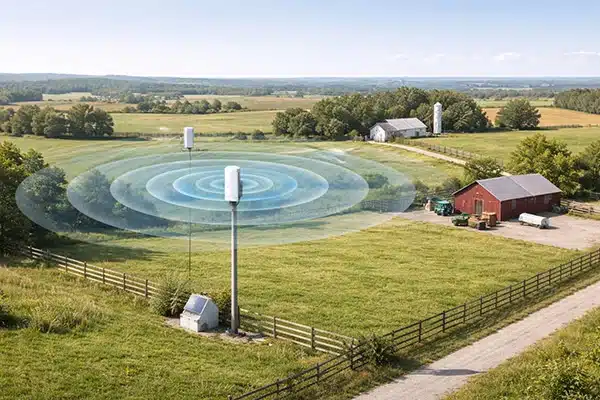
Farms & Open Ground
A better fit for exposed wide-area coverage than indoor repeaters.

Gates & Fence Lines
Best when signal needs to travel forward along narrow outdoor zones.

Building-to-Building Links
Better suited to fixed remote links than general indoor signal extension.

Temporary Outdoor Sites
Useful where cable installation is slow, costly, or impractical.
Omni vs Directional / Repeater vs Bridge
Choose the right long range architecture based on coverage shape, target position, and deployment purpose.
Omni vs Directional

Omni Coverage
Best for wider all-around outdoor coverage.
-
Covers users in multiple directions
-
Better for general outdoor access
-
Easier for broader-area deployment

Directional Coverage
Best for focused outdoor reach toward a target area.
-
Better for forward-facing coverage
-
More efficient for narrow target zones
-
Often stronger for edge reach
Choose Omni when users are spread around the device. Choose Directional when the signal needs to travel mainly in one direction.
Omni vs Directional

Repeater / Extender
Best for extending coverage from an existing WiFi area.
-
Fast way to extend existing coverage
-
Useful for broader client access
-
Good for access expansion, not dedicated backhaul

Bridge / Point-to-Point Link
Best for connecting fixed remote points or separate buildings.
-
Better for fixed-point wireless connection
-
More suitable for dedicated backhaul tasks
-
Stronger fit for remote endpoint connectivity
Choose Repeater when the goal is wider client coverage. Choose Bridge when the goal is a stable wireless link to a fixed remote point.
OEM / ODM Evidence for Long Range WiFi Repeater Projects
Customization should improve deployment fit, installation efficiency, and project compatibility—not just change the appearance.
Hardware & PCBA Engineering
Built for buyers who need more than a standard public-board solution.
-
100% in-house hardware development
-
MediaTek / Realtek platform integration
-
Custom ports, power, and PCB layout support
Firmware & Software Support
Suitable for projects that need branded UI, protocol features, or secondary development.
-
OpenWrt-based customization
-
TR-069 / TR-181 integration
-
Multi-language UI and white-label web panel
Rapid Tooling & ID Design
Designed for projects that need private mold, modified housing, or faster sample validation.
-
T0 sample in 25 days
-
In-house tooling and mold-flow review
-
Custom material, finish, and logo options
RF Testing & Quality Control
Used to support more stable wireless performance and lower production risk.
-
In-house 3D OTA chamber
-
LitePoint IQxel calibration
-
Burn-in test from -20°C to 60°C
Production Capacity
Suitable for repeat orders, peak-season supply, and distributor-level programs.
-
8 automated Fuji SMT lines
-
30,000 units/day peak capacity
-
10,000 m² smart manufacturing facility
Lead Time & Supply Chain
Built for faster rollout when the project uses mature repeater platforms.
-
35–45 days for mature PCBA orders
-
Strategic chipset supply support
-
Better fit for scalable B2B programs
Typical OEM / ODM Scope
| OEM / ODM Item | Typical Support | What Buyer Can Confirm |
|---|---|---|
| Logo / branding | Yes | Device logo, label, carton artwork |
| Plug localization | Yes | EU / US / UK / AU plug options |
| Packaging customization | Yes | Gift box, carton mark, manual layout |
| Web UI / app branding | Project-based | UI screenshot or branding sample |
| Firmware feature adjustment | Project-based | Function list confirmation |
| Memory / flash configuration | Project-based | BOM / spec confirmation |
| Certification support | Project-based | Compliance file path by market |
| Sample validation | Yes | Pre-production sample review |
| Pilot run / trial order | Project-based | Trial quantity discussion |
| Mass production release | Yes | QC checkpoints after approval |
For long range projects, useful customization is not only cosmetic—it should improve installation, coverage logic, and deployment compatibility.
Need a reliable long range WiFi repeater OEM / ODM partner?
Talk to our team about firmware, housing, interface, and packaging customization.
Home WiFi Repeater FAQ
These questions cover the most common concerns around indoor deployment, product tier selection, and OEM planning for home WiFi repeater programs.
1.How far can a long range WiFi repeater really reach?
A true home WiFi repeater is designed for indoor room-to-room coverage extension, not outdoor relay or long-distance bridging. The key traits are compact form factor, simple setup, and residential deployment fit.
2. Is a long range repeater the same as a wireless bridge?
No. A repeater extends coverage. A bridge connects fixed remote points.
3. When should I choose directional instead of omni?
Use directional for forward-focused coverage. Use omni for wider all-around coverage.
4. Is 2.4 GHz always better for long range?
Usually better for reach, but not always better for capacity or interference control.
5. Why do some “long range” products still perform poorly on site?
Because range is not decided by radio power alone. Poor installation height, blocked line of sight, weak upstream signal, bad antenna matching, and heavy RF interference can all reduce real-world performance.
6. Does higher antenna gain always mean better performance?
No. Higher gain improves focus, but not every deployment benefits from a narrower beam.
7. Can a long range repeater replace extra AP deployment?
Only in some cases. Larger projects may need dedicated AP or bridge-based architecture.
8. What matters more in outdoor long range deployment: radio specs or installation?
Both matter, but installation is often underestimated. Mounting position, pole height, cable routing, grounding, surge protection, and enclosure quality can affect deployment results as much as chipset or transmit specifications.
9. What is the most common mistake buyers make with long range WiFi products?
Treating all long range as the same. Some projects need wider outdoor coverage, some need directional reach, and others need fixed-point wireless links. Wrong product type selection causes more issues than lack of power.
10. What OEM / ODM details should a serious supplier be able to provide?
Antenna options, housing grade, PoE design, interface layout, MOQ, sample lead time, and validation process.
Find the Right WiFi Solution for Your Needs
Explore by Product Type
👉 Compare different WiFi expansion solutions based on performance and usage.
Explore by WiFi Standard
👉 Choose based on speed, performance, and compatibility.
Explore by Application Scenario
👉 Find the best solution for your specific environment.
Explore by Installation Type
👉 Please make your selection based on the wireless repeater’s interface and installation method.
Contact Us
Please fill out the form below, and our professional consultants will assist you as soon as possible, typically within 24 hours.
Contact Information
Phone: +8618682468703
WhatsApp: +8618682468703
Email: addway.wang@lgxlgx.com
Address: Room 301, Building A2, Qiangrong East Industrial Zone, No. 723 Zhoushi Road, Hangcheng Street, Shenzhen, Guangdong, China