WiFi Repeater with Ethernet Port
Extend WiFi Coverage up to 300–1500 m² Without Rewiring
-
Tested in 2.4GHz: up to 120m indoor coverage (open environment)
-
Dual-band throughput up to 1200Mbps (IEEE 802.11ac)
-
Reduce dead zones by >85% in multi-room layouts
WiFi Repeater Categories
By Product Type
Wireless wifi repeater
- Repeater wireless wifi
- Wireless and wifi repeater
- Wireless wifi repeater
- Wifi repeater wireless signal booster
- Wireless wifi extender repeater
Wifi range extenders
WiFi Signal Boosters
By Standard
-
Single Band & Dual Band
-
WiFi 5 Repeaters
-
WiFi 6 Repeaters
-
WiFi 7 Repeaters
By Scenario
-
Home WiFi Repeaters
-
Outdoor WiFi Repeaters
-
Long Range WiFi Repeater
-
Camper WiFi Repeaters
By Installation
-
WiFi Repeater with Ethernet Port
-
Plug WiFi Repeater
-
WPS WiFi Repeaters
-
WiFi Repeater External
Explore WiFi Range Extender Types

Plug-in Range Extender
Model:
Speed:
Chipset:
Antenna:
Coverage:
👉 Best for home use (<150m²)
Wall-mounted Industrial Extender
Model:
Speed:
Chipset:
Antenna:
Coverage:
👉 Long range / high stability
Outdoor WiFi Extender
Model:
Speed:
Chipset:
Antenna:
Coverage:
👉 IP65 waterproof / long-distance transmission
Mesh-Compatible Extender
Model:
Speed:
Chipset:
Antenna:
Coverage:
👉 Seamless roaming support
How to Choose the Right WiFi Range Extender
Choosing the right extender depends on coverage area, obstacles, and device load — not just speed.
Key Factors to Consider
-
Coverage Area (m²)
-
Number of Walls / Obstacles
-
Required Speed (Mbps)
-
Number of Connected Devices
-
Indoor or Outdoor Use
-
Signal Interference Level
Recommended Specifications by Scenario
| Scenario | Coverage Area | Recommended Speed | Device Support |
|---|---|---|---|
| Small Apartment | <100 m² | 300–750 Mbps | 5–10 devices |
| Medium House | 100–300 m² | 750–1200 Mbps | 10–25 devices |
| Large House / Villa | 300–500 m² | 1200+ Mbps | 20–40 devices |
| Industrial / Warehouse | 500m²+ | High power + external antenna | 30–50 devices |
Not sure which model fits your needs?
What is a WiFi Range Extender?
A device that expands WiFi coverage with stronger signal output and lower speed loss than traditional repeaters.

Extends Existing WiFi Coverage
Connects to your router and rebroadcasts signal to eliminate dead zones.
Coverage increase up to 150%–300% (tested in multi-room layouts)

Lower Speed Loss than Repeaters
Uses better signal handling or dedicated channels to maintain higher throughput.
Speed loss typically 10–30% vs 40–60% in repeaters

Designed for Larger Spaces
Ideal for multi-room homes, offices, and industrial environments.
Recommended for areas >100m² with multiple walls or obstacles
WiFi Range Extender vs WiFi Repeater (Key Differences)
Range extenders deliver 2–3× more coverage and up to 50% less speed loss compared to standard WiFi repeaters.
Based on dual-band AC1200 devices tested in multi-room indoor environments.
| Feature | WiFi Range Extender | WiFi Repeater |
|---|---|---|
| Coverage Increase | +150%–300% | +50%–120% |
| Speed Loss | 10%–30% | 40%–60% |
| Signal Stability | High (dedicated channel optional) | Medium |
| Backhaul Type | Wired / Dual-band / Dedicated | Shared wireless |
| Best Use Case | Large homes, offices, industrial | Small apartments |
| Multi-device Support | 20–50 devices | 5–15 devices |
👉 See Detailed Comparison Page →
Why Range Extenders Perform Better
-
Uses dual-band separation (reduces interference)
-
Some models support wired backhaul
-
Higher transmit power (typically 20–30% stronger)
Why Repeaters Lose Speed
-
Same channel receive + transmit
-
Bandwidth is halved during relay
-
More interference in dense environments
Still not sure which one fits your project?
Where WiFi Range Extenders Perform Best
Optimized for large spaces, complex layouts, and signal-challenging environments.
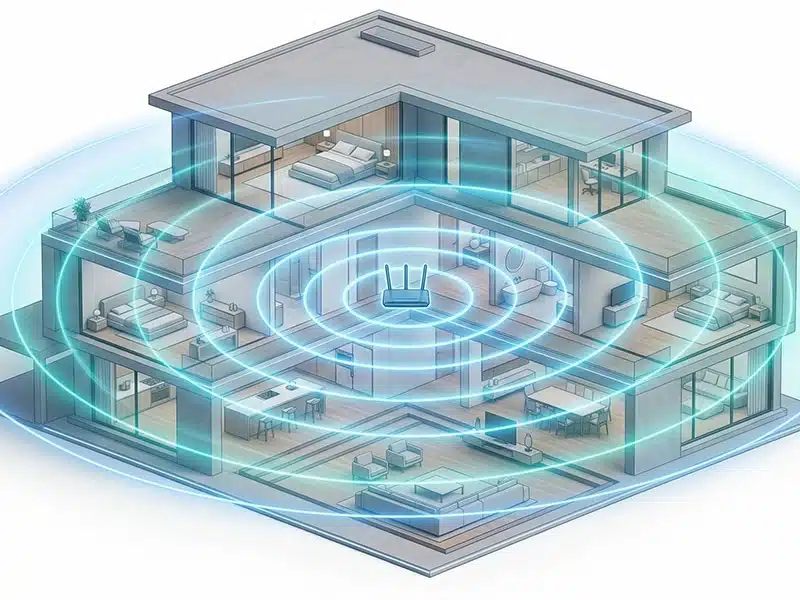
Large Residential Houses
Eliminates dead zones across multiple rooms and floors.
Coverage: 150–500 m² | 2–3 floors supported
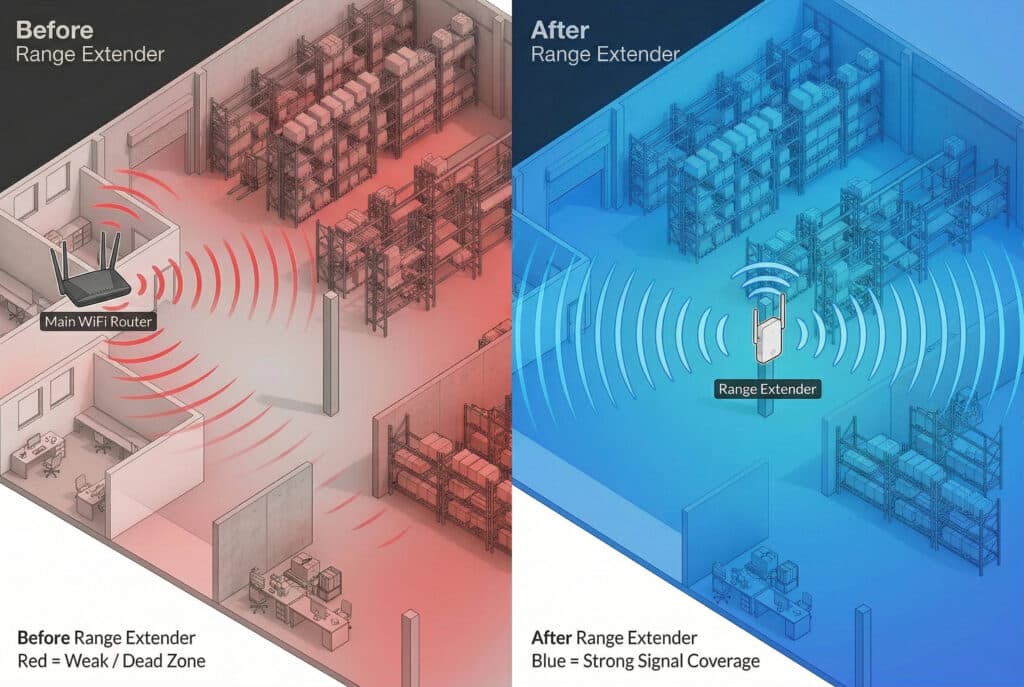
Warehouses & Factories
Maintains stable signal across long distances and obstacles.
Coverage up to 1000 m² | Signal penetration through metal shelving

Multi-room Offices
Reduces signal attenuation caused by walls and partitions.
Signal improvement: -75dBm → -55dBm (typical office test)
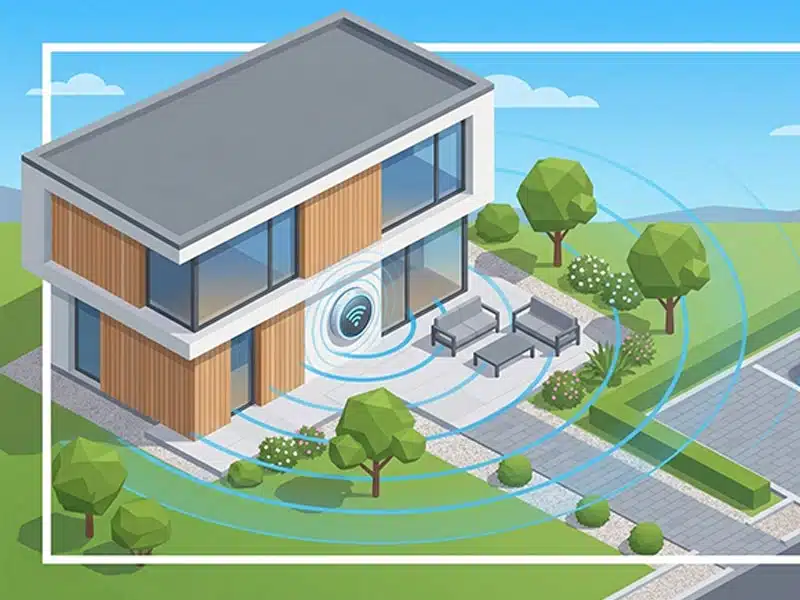
Outdoor & Semi-Outdoor Areas
Extends coverage to gardens, parking lots, and open spaces.
Outdoor range: up to 100m (open environment)
Real Performance Data (Lab & Field Tested)
Range extenders improve signal strength by up to 20–30 dBm and maintain stable throughput under multi-device load.
| Test Scenario | Before Extender | After Extender |
|---|---|---|
| Signal Strength (3 walls) | -78 dBm | -55 dBm |
| Throughput (5GHz) | 180 Mbps | 520 Mbps |
| Latency (20 devices) | 85 ms | 32 ms |
| Packet Loss | 12% | <2% |
| Coverage Area | 90 m² | 260 m² |
Test Insights
-
Signal measured using standard RSSI tools
-
Tested across 2–3 walls indoor environment
-
Devices: smartphone + laptop mixed load
-
Continuous streaming + browsing simulation
Test Environment Overview
Router Standard
WiFi 5 (802.11ac)
Frequency Bands
2.4GHz + 5GHz dual-band
Test Distance
10–30 meters indoor
Obstacles
2–3 concrete walls
Want detailed performance benchmarks?
View Full Test Report →
WiFi Range Extender FAQs
Common questions about performance, coverage, and setup.
Q1 Does a WiFi range extender reduce internet speed?
Yes, but typically only by 10–30% depending on the connection type. Dual-band or wired backhaul extenders maintain higher speeds compared to standard repeaters, which may lose 40–60% bandwidth.
Q2 How far can a WiFi range extender reach?
Indoor coverage is usually 10–30 meters, depending on walls and interference. In open outdoor environments, the range can extend up to 100 meters.
Q3 Is a WiFi extender better than a repeater?
Yes, for larger areas. Range extenders provide stronger coverage and lower speed loss, making them suitable for homes over 100m² and commercial environments.
Q4 How many WiFi extenders can I use in one network?
It is recommended to use no more than 2–3 extenders in a single network to avoid interference and signal overlap.
Q5 Where should I place a WiFi range extender?
Place it halfway between the router and the weak signal area. The extender should still receive a strong signal (above -65 dBm) for optimal performance.
Q6 Do WiFi extenders work through walls?
Yes, but signal strength decreases with each wall. Concrete walls can reduce signal by 10–15 dB, while drywall has less impact.
Q7 Can a WiFi extender support multiple devices?
Yes. Most dual-band extenders support 20–50 devices, depending on bandwidth and network conditions.
Q8 Do I need a mesh system instead of an extender?
Mesh systems are better for seamless roaming, while extenders are more cost-effective for improving coverage in specific areas.
Explore More Solutions
Find the right WiFi range extender for your space and requirements.
Need personalized recommendation? Get a free consultation →
Find the Right WiFi Solution for Your Needs
Explore by Product Type
-
Wireless WiFi Repeater
-
WiFi Range Extenders
-
WiFi Signal Boosters
👉 Compare different WiFi expansion solutions based on performance and usage.
Explore by WiFi Standard
-
Wireless-N WiFi Repeaters
-
WiFi 5 Repeaters
-
WiFi 6 Repeaters
-
WiFi 7 Repeaters
👉 Choose based on speed, performance, and compatibility.
Explore by Application Scenario
-
Home WiFi Repeaters
-
Outdoor WiFi Repeaters
-
Long Range WiFi Repeaters
-
Camper WiFi Repeaters
👉 Find the best solution for your specific environment.
Explore by Installation Type
-
WiFi Repeater with Ethernet Port
-
Plug WiFi Repeater
-
WPS WiFi Repeaters
-
External Antenna Repeaters
👉 Please make your selection based on the wireless repeater’s interface and installation method.
Contact Us
Please fill out the form below, and our professional consultants will assist you as soon as possible, typically within 24 hours.
Contact Information
Phone: +86-13923714138
WhatsApp: +8613923714138
Email: addway.wang@igrentech.cn
Address: Room 301, Building A2, Qiangrong East Industrial Zone, No. 723 Zhoushi Road, Hangcheng Street, Shenzhen, Guangdong, China